

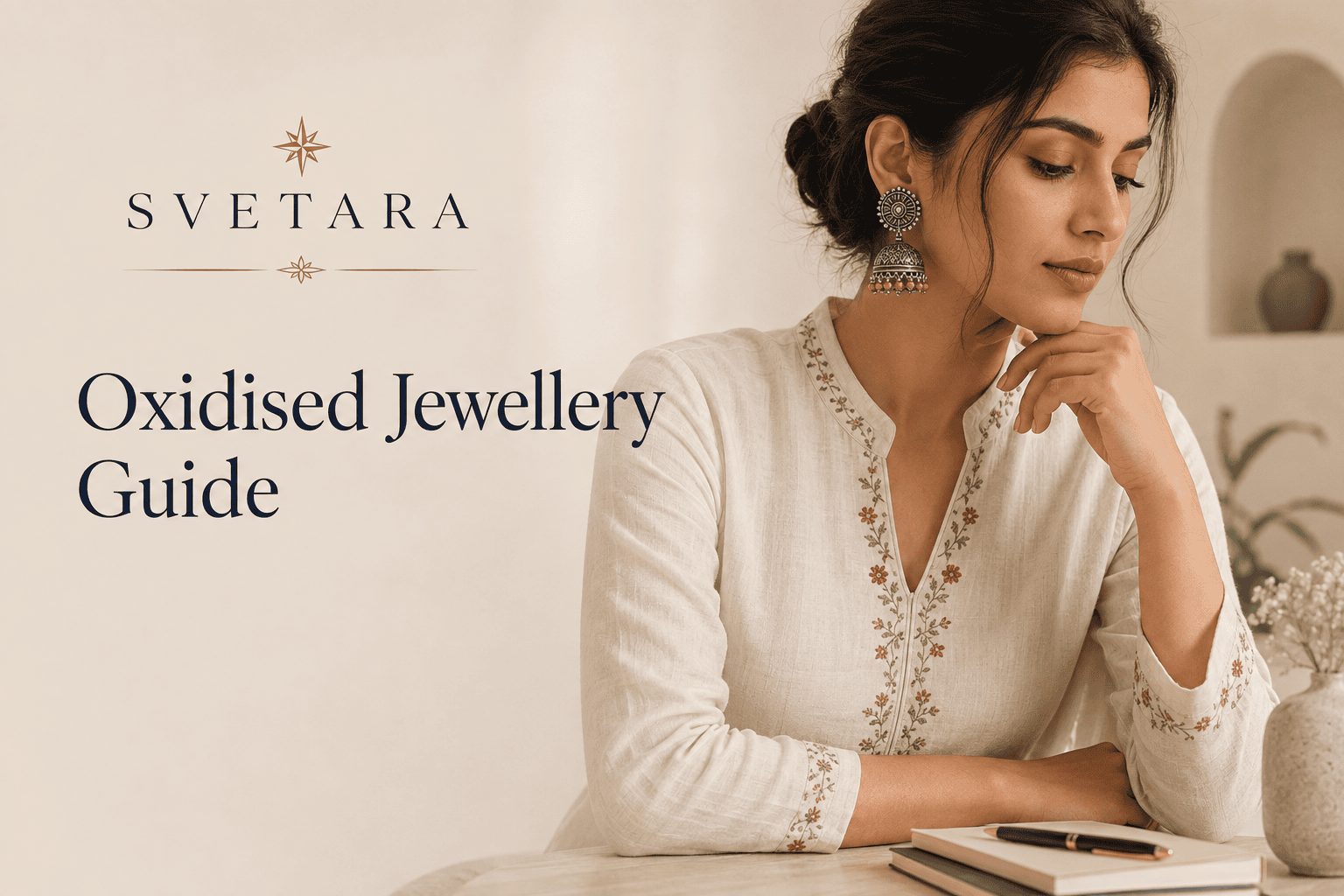
Oxidised jewellery has become one of the easiest ways to bring character into Indian and Indo-Western dressing. Its antique silver-tone appearance works with cotton kurtis and sarees, but it can look equally striking with shirts, dresses, denim and contemporary silhouettes.
The secret is not simply owning oxidised jewellery. It is knowing which design, scale and colour combination works with the outfit you are wearing.
What is oxidised jewellery?
Oxidised jewellery refers to jewellery whose surface has been given a deliberately darkened or antique-looking finish. The recessed parts of the design often appear darker, helping engraved patterns, floral motifs and traditional detailing stand out more clearly.
This gives oxidised jewellery its distinctive heritage-inspired character and makes it visually different from highly polished gold-tone or bright silver-tone fashion jewellery. For a broader comparison of materials, purpose and styling, see our fashion jewellery vs fine jewellery guide .
Why is oxidised jewellery so popular?
Oxidised jewellery is popular because it sits comfortably between traditional and contemporary fashion. A single pair of oxidised earrings can make a simple kurti feel more styled, while the same pair can create contrast with denim or a white shirt.
Strong visual detail
Darkened grooves make engraved motifs and textures easier to see.
Works with Indian clothing
Kurtis, sarees, suits and handloom fabrics pair naturally with oxidised designs.
Easy fusion styling
Oxidised earrings can add an Indian element to shirts, denim and dresses.
Many personalities
Choose minimal silver-look pieces or colourful enamel, beads, stones and jhumkas.
Is oxidised jewellery real silver?
Not necessarily. Oxidised jewellery may be made from different metals or jewellery alloys and then given an antique silver-tone or darkened finish.
Genuine oxidised silver jewellery also exists, but the word oxidised by itself does not prove silver purity. If precious-metal content matters to you, look for clearly stated metal composition and hallmark information where applicable.
What is the difference between oxidised jewellery and silver jewellery?
| Feature | Oxidised Fashion Jewellery | Silver Jewellery |
|---|---|---|
| Main meaning | Describes an antique or darkened finish/style | Describes jewellery made with silver |
| Material | May use jewellery alloy or other base metals | Silver content should be specified |
| Appearance | Often dark, antique and highly textured | Can be polished, matte, oxidised or otherwise finished |
| Typical styling | Fashion, ethnic, fusion and occasion styling | Depends on individual design |
What outfits look best with oxidised jewellery?
Oxidised jewellery works especially well when there is visual contrast between the metal finish and the fabric. Solid kurtis, cotton sarees, handloom textiles, black clothing, denim and white shirts are particularly easy starting points.
Kurti + oxidised jhumkas
One of the easiest combinations. A plain kurti can handle larger earrings, while a heavily printed kurti usually looks better with a quieter pair.
Saree + oxidised chandbalis
Chandbalis bring a softer curved silhouette to cotton, linen, printed and festive sarees.
White shirt + oxidised earrings
A clean white shirt gives detailed oxidised earrings plenty of visual space and creates an effortless fusion look.
Denim + statement oxidised earrings
Keep the clothing simple and allow one artistic pair of earrings to become the Indian element in an otherwise modern outfit.
How do you style oxidised jewellery with a kurti?
Start by looking at how much visual detail is already present in the kurti. Plain cotton and solid-colour kurtis can support larger jhumkas, medallion earrings or colourful oxidised designs.
Printed or embroidered kurtis often need less jewellery. In that case, choose a smaller pair of earrings or allow one feature—such as coloured stones or enamel—to coordinate with the outfit. For more outfit-specific combinations, continue with our kurti, Anarkali and salwar suit jewellery guide .
How do you wear oxidised jewellery with a saree?
Oxidised earrings complement cotton, linen, handloom, printed and many contemporary sarees particularly well. Jhumkas create a strongly traditional mood, while chandbalis feel slightly softer and more decorative.
If the saree has a large border or elaborate blouse, you may only need earrings. With a very plain saree, you can introduce a stronger earring silhouette or add another restrained accessory.
Can you wear oxidised jewellery with Western outfits?
Absolutely. Oxidised jewellery can create a strong Indo-Western look because its intricate Indian character contrasts well with simple Western silhouettes. For more combinations with denim, dresses, shirts and blazers, see our Indian jewellery with Western outfits guide .
| Western Outfit | Oxidised Jewellery Idea | Styling Approach |
|---|---|---|
| White shirt | Jhumka or detailed drop earrings | Skip a heavy necklace and let the earrings lead |
| Blue jeans + solid top | Colourful oxidised earrings | Use jewellery to add the Indian/fusion element |
| Black dress | Silver-look chandbalis | The dark outfit provides strong metal contrast |
| Denim jacket | Artistic jhumkas or medallion earrings | Keep other accessories restrained |
| Blazer | One controlled oxidised statement piece | Best for creative or relaxed work settings |
Which colours look best with oxidised jewellery?
Oxidised silver-tone jewellery is unusually versatile because its darker finish creates contrast with both neutrals and saturated Indian colours.
Black
One of the strongest pairings. The silver-tone detailing becomes highly visible against black.
White & Ivory
Creates a clean, modern contrast that works particularly well for fusion outfits.
Indigo & Denim Blue
Naturally complements antique silver-tone finishes and colourful enamel details.
Mustard, Rust & Maroon
Earthy colours work beautifully with the darker, heritage-inspired appearance.
Green & Teal
Especially effective when the jewellery itself contains green stones or enamel.
Pink & Red
Adds festive warmth and works well with colourful oxidised Indian jewellery.
What is an oxidised jhumka?
An oxidised jhumka combines the familiar bell-shaped jhumka silhouette with an antique silver-tone or darkened finish. Designs may also incorporate beads, enamel, stones, textile details, engraving or pearl-style drops.
Because the jhumka shape itself is strongly associated with Indian jewellery, oxidised versions work particularly well with kurtas, sarees and festive clothing—but modern designs can also be worn with dresses and denim.
What is an oxidised chandbali?
A chandbali is recognised by its crescent or moon-inspired curved shape. An oxidised chandbali combines that silhouette with an antique silver-tone finish and often includes engraved motifs, coloured stones, beads or pearl-style drops.
Chandbalis can feel slightly more graceful and dressy than many jhumka silhouettes, making them useful for sarees, festive kurtas, wedding-guest looks and Indo-Western outfits.
How do I keep oxidised jewellery from looking overdone?
The simplest strategy is to treat your oxidised jewellery as the focal point rather than building several competing focal points.
SVETARA oxidised jewellery picks
These current SVETARA designs show four different directions within oxidised jewellery—from refined chandbalis to colourful jhumkas and artistic fusion pieces. To see how oxidised styles fit into the wider fashion picture, explore our latest artificial jewellery trends in India .
Green stones, engraved oxidised detailing and white faux pearl drops give this pair a refined traditional character. Style it with sarees, kurtas or elegant Indo-Western outfits.
View ChandbalisAn intentionally asymmetric pair combining oxidised silver-tone metal with colourful textile patterns and bead details. An excellent choice for artistic Indo-Western styling.
View JhumkasPeacock motifs, pink and orange enamel and black bead drops give this oxidised pair a youthful fusion personality for kurtas, cotton sarees, dresses and casual occasions.
View EarringsTeal and muted rose enamel combine with oxidised silver-tone detailing, a peach-coloured stone and faux pearl drops for a softer festive interpretation of the jhumka.
View JhumkasHow should you care for oxidised fashion jewellery?
Fashion jewellery lasts better when it is protected from moisture, cosmetics and unnecessary friction. The objective is to preserve the finish rather than aggressively polishing away the darker detailing that gives oxidised jewellery its character. For a more complete cleaning and storage routine, see our fashion and imitation jewellery care guide .
- Keep jewellery dry.
- Avoid direct contact with perfume, hairspray and cosmetics.
- Remove jewellery before bathing, swimming or exercising.
- Wipe gently with a clean, soft and dry cloth after wearing.
- Store pieces separately to reduce scratching and tangling.
- Avoid harsh cleaners unless the product specifically allows them.
- Do not aggressively polish antique detailing.
How do I choose oxidised jewellery for different occasions?
| Occasion | Good Starting Point | Styling Mood |
|---|---|---|
| College / Casual | Colourful jhumkas or compact oxidised earrings | Youthful and expressive |
| Office | Smaller oxidised earrings | Subtle Indian detail |
| Festive outing | Jhumkas, chandbalis or medallion earrings | Traditional with personality |
| Wedding guest | More detailed chandbali or statement earrings | Elevated ethnic |
| Indo-Western party | One artistic statement pair | Fusion and contemporary |
Oxidised jewellery styling checklist
- Is the outfit plain or already visually busy?
- Do I want the jewellery to look traditional or fusion?
- Should the earrings be the main statement?
- Does one colour in the jewellery connect naturally with the outfit?
- Is the size comfortable for the occasion?
- Have I avoided adding too many competing accessories?
Frequently asked questions about oxidised jewellery
What is oxidised jewellery?
Oxidised jewellery is jewellery given a darkened or antique-looking surface finish. The darker recessed areas help engraved patterns and traditional detailing appear more prominent.
Is oxidised jewellery made of silver?
Not always. Oxidised describes a finish or appearance rather than guaranteeing a particular metal. Fashion jewellery may use jewellery alloys with an oxidised silver-tone finish, while genuine oxidised silver jewellery also exists.
Can oxidised jewellery be worn with kurtis?
Yes. Oxidised earrings and jhumkas are especially easy to style with kurtis. Plain kurtis can support larger statement pieces, while printed or embroidered kurtis usually benefit from simpler jewellery.
Does oxidised jewellery look good with sarees?
Yes. Oxidised jewellery pairs particularly well with cotton, linen, handloom, printed and contemporary sarees. Jhumkas create a traditional look while chandbalis can add a softer decorative silhouette.
Can oxidised jewellery be worn with Western outfits?
Yes. Oxidised earrings can create an Indo-Western contrast with white shirts, jeans, dresses, denim jackets and simple contemporary outfits.
Which colours look best with oxidised jewellery?
Black, white, ivory, indigo, denim blue, mustard, rust, maroon, green and teal all pair well with oxidised silver-tone jewellery. The best choice also depends on the colours used within the jewellery itself.
Can I wear oxidised jewellery every day?
Many lightweight oxidised fashion jewellery pieces can work for everyday styling. Choose comfortable sizes and keep them away from water, perfume, sweat and harsh chemicals to help preserve the finish.
How should oxidised jewellery be stored?
Keep it dry and store individual pieces separately in a pouch or compartment. This helps reduce scratching, tangling and unnecessary contact with moisture or other jewellery.
Find your next jewellery story
Explore statement earrings, everyday styles and new jewellery designed for Indian, Western and fusion dressing.
Traditional. Contemporary. Completely yours.
Discover jewellery that moves easily between kurtis, sarees, denim, dresses and everything in between.
Explore New Arrivals


